Friday, July 19, 2013

The next day

Day 2, we woke up bright and early because we were all super jet-lagged, and didn't have much choice waking up early or not. The Chinese have different concepts of privacy than we do in the US. For example, the bathroom was sectioned off from the rest of our hotel room... by glass. Alex and I adapted it so we could modestly take shits:

Right off the bat we started doing all the things the nurse practitioner told us not to do, buying food and drinks from the street vendor and going out without sunscreen. Armed with a big bag of what translated out as "grease sticks" and "grease balls," we boarded a fishing boat we chartered for a couple hundred yuan so we could see the very end of the Yangtze river. Here's the boat in the harbor!


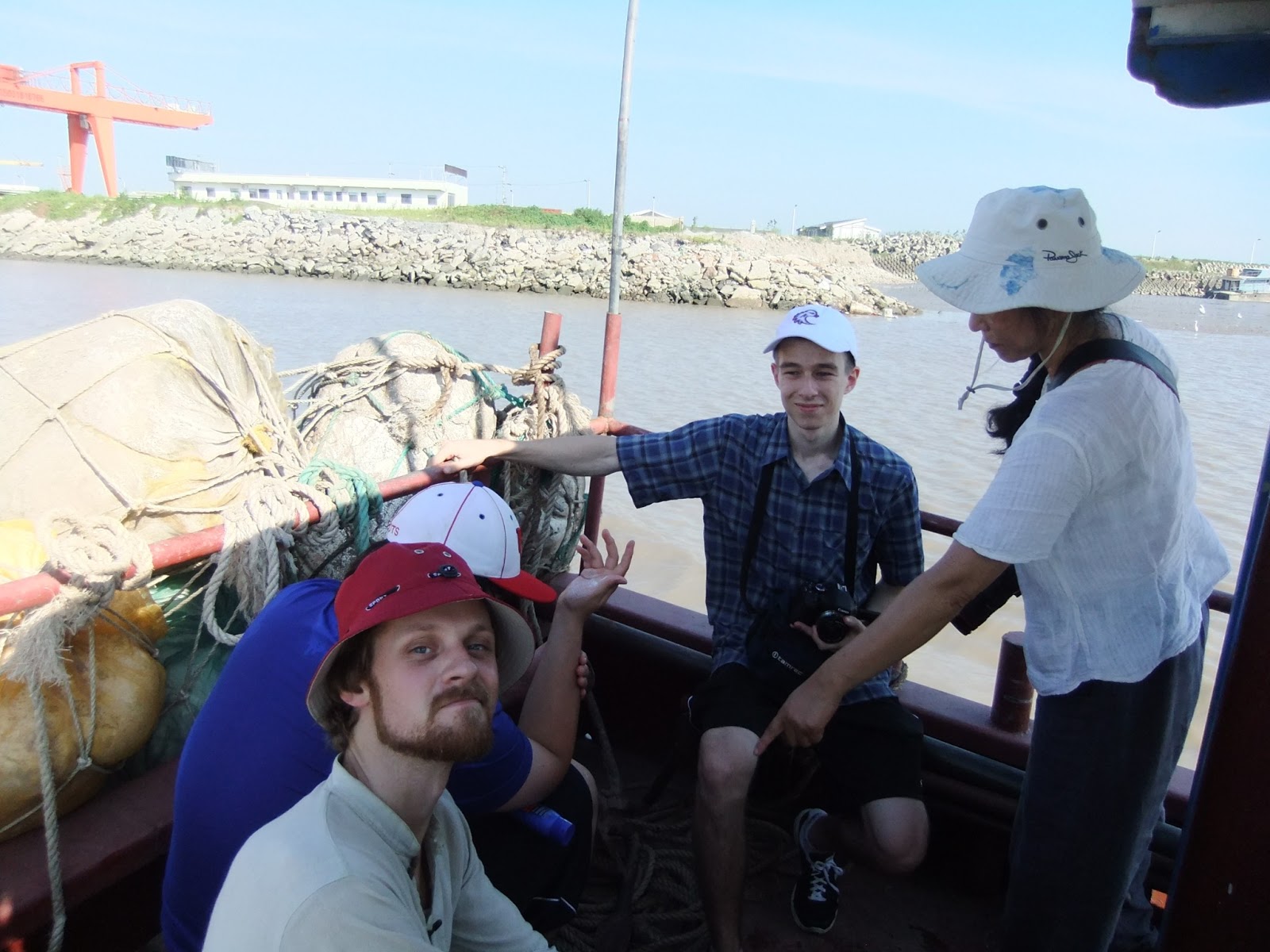
And here's everyone on the boat:

There's loads of industrial stuff going on around Pudong, even right where all the fishing is going on. Most of the industrial stuff seemed to be based around big piles of gravel.

After a long boat ride, during which I got kinda sunburnt, we boarded the island which marks the end of the Yangtze as it flows into the East China Sea. On the way up, I slipped on the dock and scratched up my leg on a bunch of barnacles, and it started bleeding like no tomorrow. Here's where we went:

Well, we got off and started hanging our river flags, and right off the bat some guy came storming down the docks telling us we weren't allowed to be here and we had to get off the island. That was going to be a problem because the fishing boat wasn't going to come back for another hour and had just gotten out of shouting distance. But Ping managed to sweet talk our way out of leaving as soon as possible, and we hung out and made some friends with the folks who didn't want us on the island. They let us use their bathroom, and they even ended up cleaning out and sterilizing my barnacle-scratches. One of the guys spent about five minutes talking very enthusiastically about something that Ariel deduced to be fish. Mississippi Bluesman Alex Wand managed to get out "I don't speak any English," in broken Chinese, at which the fish enthusiast just laughed, and went on for another five minutes. The flags that we did manage to get up were beautiful though:


Here's what they looked like fluttering in the wind:

Well, the next post will be more about day 2. Shanghai deserves it's own post.

Thursday, July 18, 2013

Lots of stuff!

Dear River Friends,

Let's bring you up to snuff.

First, we arrived safe and sound in Shanghai, so if you haven't heard from any of us, don't worry!
Here we are at the airport:

After a good long wait for the rickety unairconditioned shuttle, we arrived at our hotel in Pudong, the last town on the Yangtze before it empties out into the East China Sea. We had dinner in a tiny little fish restaurant where we picked out the fish we wanted to eat from styrofoam coolers, and then they cooked them up. In restaurants like these, there aren't any waiters. If you want to order something, or if your order's taking too long, you walk right up to the kitchen and holler right inside at the cooks. Ping did the hollering. 

Here's the outside of the restaurant, which was also a fish market:
Here, wait, lemme introduce you to everyone, so you can tell who everyone all is in all these pictures:

Right here's Mississippi Bluesman Alex Wand, playin the guitar. He plays a custom-made National guitar designed by composer Lou Harrison, with frets designed for a just intonation tuning system, based on the harmonic series. There are only 5 that exist!:


Here we've got wiz-kid videographer Alex Howard. He's only just graduated high school, but shoots video with the best of 'em. He's got right here Canon T3I with a Tokina 16-mm superwide lens on a Glidecam HD 100 stabilizer. There are more than five of them that exist:

Ariel Lerner, holding a large lollipop:

Wang Ping, internationally renowned author, river queen, beloved professor, Chinese medicine doctor, champion oarswoman, skilled musician, award-winning figure skater, professional flamenco dancer, talented photographer, master chef, deadly swordswoman, academic freedom fighter, adventurer:


And here's me! Oliver St. John, Kinship of Rivers blogger extraordinaire, your buddy on the this adventure:

Anyway, that's just the first day. I'll tell you about the next day in the next post!

Love,

-Oliver

Saturday, July 13, 2013

Dear river friends,

On Monday around 11:30, Wang Ping, Alex Howard, Ariel Lerner, and myself, Oliver St. John, are taking off for China!

We're all scrambling to make sure we've gotten everything together -- Ping managed to fit all the river flags into a big heavy suitcase, and I've started blogging! (Just about a minute or so ago.)

Want to know how our River Journey's going? Just follow this blog! I'll be posting regularly with stories and pictures and poems as we travel through China.

Scott Gannis made us this interactive map. Here's where we're we'll be going:

 
View Yangtze River Trip in a larger map

 Stay tuned for more updates! I've got my adventure hat on. Tell your friends about this blog!

Love,

-Ollie


Saturday, November 12, 2011

Kinship of Rivers Brightens a Dull Day at School


The entrance to St. Paul Academy and Summit School, a handsome brick building in St. Paul, features a two story open foyer with top-to-bottom windows that face Davern Street to the east. That is where we hung several Kinship of Rivers banners during our recent visit. The sky outside the windows was overcast but the flags in multi colors, each with a unique design, brightened the space and made people stop and smile.

Ping had been invited to speak and sign books as a featured author for the annual school book fest (Wednesday, November 9). She spent the morning autographing books and chatting with students, parents and staff about her work. She was interviewed for the school newspaper, The Rubicon.

After a delicious lunch in the cafeteria, Ping and I met with Kathryn Campbell’s poetry class to conduct a Kinship of Rivers workshop. It included a talk by Ping about her life as an author. She told how she received very little formal schooling during the Cultural Revolution and how she taught herself many things by breaking the rules and reading forbidden books. She has continued to teach herself new things by learning the rules first—like with poetry—and then breaking them.

Nothing could have inspired a class of sixteen- and seventeen-year-olds more than an invitation to break the rules. We brought out the colored cloth and the paints for the students and they worked steadily until we had a new banner’s worth of beautiful river flags filled with words and images dedicated to the rivers.

Sunday, October 9, 2011

River Meets Soap

There’s poetry to be found in the intriguing name--Soap Factory. Kinship of Rivers was recently invited to conduct an event at the Soap Factory art gallery in Minneapolis. The gallery is located in a large historic building, formerly the National Purity Soap Company warehouse. Kinship of Rivers was a featured art event on Saturday, October 8 during an open house. Soap Factory wants to attract attention during its bid for needed funds to continue restoration efforts. All the local historic sites hoping to receive money from the American Express Partners in Preservation Program held open houses this past weekend. The goal is to get folks to vote for their favorite historic site on Facebook.

The Soap Factory, located in the St. Anthony Main neighborhood was perfect for KOR because of its proximity to the Mississippi and because this art space devoted to the confluence of new ideas and new art conjures the spirit of the river. The galleries currently feature the work of artists Guo Gai, Meng Tang and Slinko. 

Kinship of Rivers took over the building’s boardwalk entryway and tall airy foyer off of Second Street. Several hundred colorful river flags hung outside the building flapped in the breeze and welcomed visitors as they approached the entrance. People also encountered Kinship of Rivers musician Carleton Macy playing the flute along with music generated by his sculptural tree of wind chimes.

Inside, more flags festooned the high ceiling of the foyer and several tables were set up for activities. Ruthann had collected leaves and grasses from the area near the river to use in printing on the fabric flags. Lisa assisted as gallery visitors of all ages used paints, crayons and a wonderful new wooden fish stamp to compose river-inspired images and messages on cloth. The room was filled with the delicious aroma of dumplings being boiled as visitors helped prepare them with Ping and Samuel.

The brick and lumber Soap Factory space feels like an old piece of sturdy clothing shining with potential—it is a raw and useful space for art but could do with some mending and refreshing. If you agree, please visit the Facebook page and vote for the Soap Factory through October 12.


Tuesday, June 7, 2011

Keeping Pace with the River: Mississippi Megalops – A Floating Chautauqua


Fast times, these times of information that flows torrentially across the Internet. There are days where I just want to turn off the glowing screen, call a halt to the mad pace and indulge my longing for slower, simpler times.

I found what I was looking for last Saturday night—a brief retreat, a summer evening on a shimmering river, the circular song of a sternwheeler paddle as it churned the Miss, the color of stout. Our vessel was the Jonathon Padelford, organized for an event called “Mississippi Megalops--A Floating Chautauqua,” a historic reference to a lively gathering of artists, educators, entertainers and an audience. There was music, art, poetry and storytelling to while away the two-hour tour of the river. That or a one could settle in a spot on the deck and simply gaze meditatively at the water.

The excursion, Mississippi Megalops – A Floating Chautauqua, was just one piece of Northern Spark, a new MN Festival modeled on a nuit blanche or “white night” festival—a dusk to dawn art and happenings event that took place June 4-5 throughout the Twin Cities. From sunset Saturday to sunrise on Sunday, more than 200 artists presented 100 installations and performances. Venues ranged from the top of the Foshay Tower to Harriet Island in St. Paul where we boarded The Jonathon Padelford.

The Mississippi Megalops event was organized by artists Colin Kloecker and Shanai Matteson of Works Progress, along with artist Andy Sturdevant. Each of the four excursions (8PM, 11PM, 2AM and 5AM) featured artists, scientists and storytellers. Wandering the boat revealed art and storytellers around every corner. Our friend and an early Kinship of Rivers supporter, Park Ranger David Wiggins was there sharing river history. Photography and paintings were on display in addition to poetry readings, music and natural history lectures. We were only part of the 8 p.m. sailing. Further trips during the night would feature new artists.

Our Kinship of Rivers team of artists, led by Wang Ping, consisted of Lucy Steinmann, Samuel Bjorgum, Tressa Versteeg, Yeshi, a Buddhist monk from Tibet and me. We brought our river flags, several hundred in number now, and hung them along the decks of the boat. While tunes from The Como Avenue Jug Band were strummed, drummed and tap-danced on the outer deck, we created our own Kinship of Rivers gallery space inside. Wang Ping provided delicious ingredients for jiaozi, Chinese dumplings, (a taste from the Yangtze River). We invited guests to join us--everything was hands-on, whether pinching dough wraps around spoonfuls of meat filling or painting and writing on hand-dyed cloth. As new river flags were created, they were hung along the walls.

It was an evening of drifting and floating but also celebrating and creating. It was just the sea change--make that river change--I had been longing for.

Sunday, April 3, 2011

Poetry and River Flags with St. Anthony Park Sixth Graders

March 15, 16, 17
The Kinship of Rivers team was invited to do a workshop in Susan Fredrickson’s sixth grade classroom at St. Anthony Park Elementary School for a few days in March. We were excited to conduct our first River Flag making workshop. We had been toying with various methods of printing on fabric and we had just launched the website that would provide input and inspiration for participants in the project.

The main idea we wanted to impart to the students was that we all have stories to tell about our lives along the river; storytelling takes many forms—poetry, pictures and especially the ethereal—that part of a story that can catch a breeze and rise above barriers of language, land and water.

The workshop involved a session of poetry writing with Wang Ping. She brought a River Flag banner made up of photographs and poetry printed on silk. Wang’s photos and poetry from the Yangtze River were mingled with photos and poetry from the Mississippi. She opened the session by telling students about her inspiration for the Kinship of Rivers project. She shared some poetry written by children. Her own poem, written that morning, about the earthquake and tsunami in Japan (which had taken place just four days previously) was especially moving.

For Japan
The earth is broken
Sky falls into swelling sea
Oh silent mother!
In the throat of fire
In the eyes of my father
A crow cries and cries
We are your children
Sendai, Fukushima, please
Take our blood, our prayers
March, you cruel month!
How many burning suns can an island take?
How long can trees last in the dark?
What alms from us would quench your wrath?
--Wang Ping


She asked students to close their eyes and find images for the haikus. She suggested a focus on things and actions. It seemed as if everyone wanted to write about the haunting and powerful disaster in Japan. Ping guided students through the steps of gathering images and words and weaving them into the syllable pattern for a haiku. Students were invited to write and draw pictures to go along their compositions. We collected their haikus and drawings for publication on the Kinship of Rivers website, www.kinshipofrivers.org

The next two days were River Flag making days with Lisa Steinmann and Wang Ping. We talked with students about pictographs, the most ancient human writing. We looked at pictographs along BWCA waterways and we looked at the characters of the Roman, Chinese and Tibetan alphabets that evolved from pictographs. We encouraged students to create an original pictograph for their River Flag.

We looked at the eight basic strokes used in creating Chinese characters. Students used their bodies to show the vertical stroke “Shu.” They stretched out one leg and bent one foot to make a hook, "Gou.” Using their arms they created various diagonal lines, such as  "Ti" and "Pie."

Students chose pieces of muslin dyed in five different colors: blue, green, red, yellow and white. We provided tools for students to try at least two methods of creating a pictograph on fabric. One method involved tracing a character on freezer paper that was then ironed on the fabric like a stencil and painted over to achieve either a positive or negative image. Another method used simple paste (flour and water) to trace a pattern on fabric. Once dried it could be cracked and painted over for a batik effect. Some students also painted their design directly on the flag with fabric paint.

The finished flags were washed, ironed and stitched on string so that they could begin their journey. The first stop is St. Anthony Park School where students can share their art in the hallway and at an outdoor site, to be determined, near the school. Photographer Lucy Steinmann documented the entire process.

The flags will continue their journey as they flutter from the deck of the Jonathon Padelford during an all night art event called ‘Mississippi Megalops – A Floating Chautauqua’  June 4/5. For more information, go to:

The flags will also be a part of the a unique and very special River Flags celebration on Sunday, July 24 at the Great River Road Learning Center in Prescott, Wisconsin. For more information, go to: http://www.freedomparkwi.org/

--Lisa